
AI adoption has exploded across industries. Its no longer experimental; it’s mainstream, from financial services and healthcare to retail and logistics and more. But with this growth comes a challenge many organisations are already feeling: soaring compute costs, stricter compliance requirements, and latency issues that threaten user experience**.**
Traditional cloud approaches aren’t keeping up. Running all inference in a centralised cloud region is costly, often non-compliant, and not optimised for the realities of today’s AI workloads.
Big Tech is feeling the pressure. In 2025 alone, Microsoft plans to spend $80B on AI-enables data centres
This isn’t a hardware problem. It’s a strategic one. The cloud-only model has hit a wall.
The true winners in AI won’t be the ones with more GPUs. They’ll be the ones with smarter infrastructure.
The Challenge of Scaling AI Workloads
Rising Compute Costs
AI infrastructure now dominates enterprise project budgets. Cloud GPU pricing highlights this: renting an NVIDIA H100 can top $65K per year, while owning equivalent hardware costs $30K–$35K over 3–5 years.
This disparity leads to bloated compute spend and eroded ROI.
Data Sovereignty & Compliance
New regulations require sensitive data to remain within national or regional boundaries. Moving workloads freely between global cloud regions is no longer viable.
Latency Constraints
Applications like fraud detection, personalised recommendations, or autonomous systems can’t tolerate the lag introduced by distant cloud regions. Real-time inference demands edge-level performance.

Why Hybrid Cloud is the Fix
This architecture isn’t optional. It’s indispensable.
Edge Inference: Deploy accelerators close to users for sub-50ms responsiveness.
In-region Data Handling: Keep sensitive data compliant and contained.
Optimise Compute Costs
By allocating workloads intelligently across cloud, edge, and on-prem resources, enterprises reduce idle GPU time and overall spend.
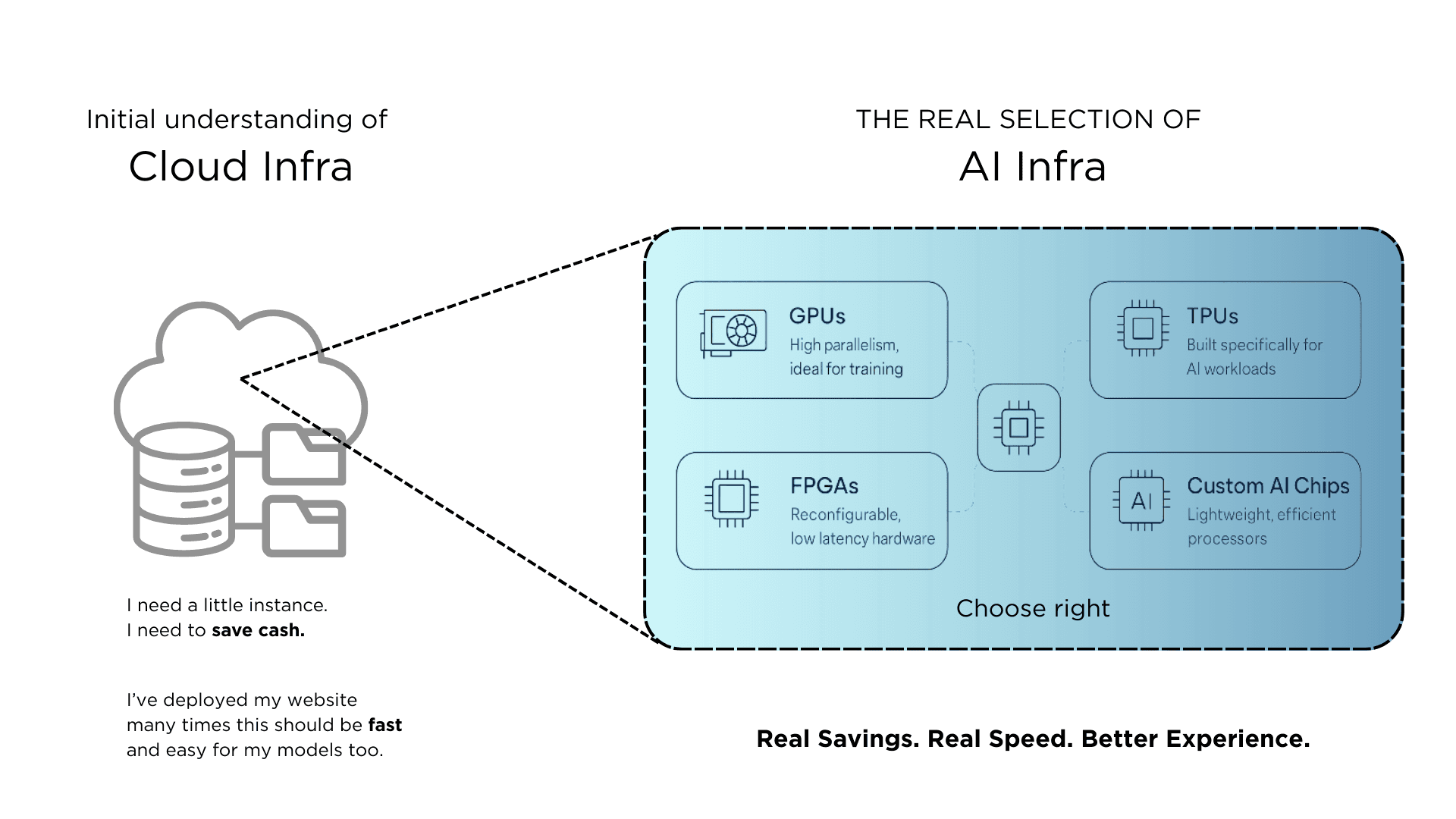
The Engine of Efficiency: Specialised Accelerators
Accelerators are the backbone of effective hybrid AI:
GPUs & TPUs for high-throughput inference
FPGAs for custom low-latency edge tasks
AI-tailored chips for energy-efficient, high-volume processing
Together, they deliver scalable performance with precision.
Real-World Applications
This model isn’t theoretical. We’re already seeing it in production:
Healthcare: Local inference at hospitals speeds up diagnostics while keeping patient data compliant.
Finance: Edge fraud detection enables instant response without moving sensitive data.
E-commerce: Personalised recommendations reach users faster and more securely.
The Bottom Line
The era of “just dump everything in the cloud” is over. AI organisations face three non-negotiable demands: cost control, compliance, and latency performance.
The future belongs to those configuring intelligent infrastructure, not just scaling hardware.
Build smarter. Not just bigger.